
Hawaii from the U.S Mainland?
Introduction
Hawaii, the 50th state of the United States, is a breathtaking island paradise located in the central Pacific Ocean. Known for its tropical climate, rich culture, and stunning landscapes, Hawaii stands apart from the rest of the U.S. due to its unique geographic location. Many people are surprised to learn just how far Hawaii is from the U.S. mainland. Unlike other states that are connected by land, Hawaii is separated by thousands of miles of ocean. This distance influences everything from travel and communication to cultural identity and economics. Understanding how far Hawaii is from the mainland not only highlights the logistical aspects of visiting or living there, but also offers insight into why the islands feel so distinct.
In this article, we’ll explore the exact distance, travel implications, and historical context that shape Hawaii’s relationship with the continental United States.
Geographic Location of Hawaii
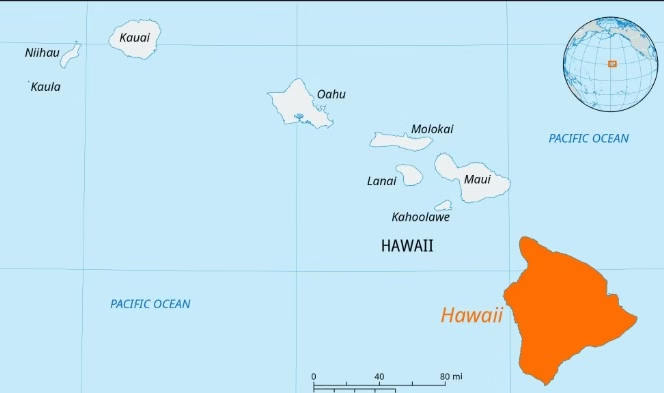
Hawaii is an archipelago made up of 137 islands, though only eight are commonly inhabited. It is located in the central Pacific Ocean, roughly between Japan and the U.S. mainland. Geographically, it sits about 2,400 miles southwest of California, making it the most isolated population center on Earth. Despite being far from any continent, Hawaii is considered part of the U.S. due to its statehood and political alignment. The islands rest along the Pacific Plate, and their volcanic origin contributes to the unique geography and biodiversity that define the region.
Distance from the U.S. Mainland
The exact distance between Hawaii and the U.S. mainland varies depending on the point of departure. From Los Angeles, California, the distance to Honolulu, Hawaii is approximately 2,470 miles (3,975 kilometers). From New York City, it stretches over 4,900 miles (7,900 kilometers). Because Hawaii is in the middle of the Pacific Ocean, it’s not connected by road or rail, making air travel the primary mode of transportation. This vast distance explains the relatively long flight times and logistical challenges involved in traveling to and from the islands.
How Hawaii Became a U.S. State
Hawaii became the 50th state of the United States on August 21, 1959. Before that, it was an independent kingdom and later a U.S. territory. The U.S. annexed Hawaii in 1898 due to its strategic location and economic value, especially for sugar plantations and naval operations. Despite being physically distant from the mainland, Hawaii’s admission into statehood was driven by both military interests and the will of its residents. Its statehood helped strengthen America’s Pacific presence and broaden the nation’s cultural and geographical diversity.
Hawaii’s Isolation in the Pacific
Hawaii is often described as the most remote inhabited place on Earth. Located over 2,000 miles from the nearest continent, its isolation has major implications. The distance affects shipping costs, import times, and even the availability of certain goods and services. It also influences ecosystems, as many plants and animals in Hawaii are found nowhere else in the world. This separation contributes to the islands’ unique sense of identity and makes Hawaii distinct even among other U.S. states.
Travel Time to Hawaii
Due to its location, traveling to Hawaii requires a considerable time commitment. A nonstop flight from the U.S. West Coast (like Los Angeles or San Francisco) to Honolulu typically takes about 5 to 6 hours. From cities on the East Coast, such as New York or Miami, flights can take 10 to 12 hours or more, often with layovers. While air travel is the most common way to reach the islands, cruises from the mainland are also available, though they take several days to complete.
Time Zone Differences
Hawaii follows Hawaii-Aleutian Standard Time (HAST), which is 10 hours behind Coordinated Universal Time (UTC-10). Unlike most U.S. states, Hawaii does not observe Daylight Saving Time. As a result, the time difference between Hawaii and the mainland varies slightly throughout the year. For example, Hawaii is typically 2 to 3 hours behind the West Coast and 5 to 6 hours behind the East Coast. These time differences can affect communication, scheduling, and even travel planning for those connecting between time zones.
Transportation Options
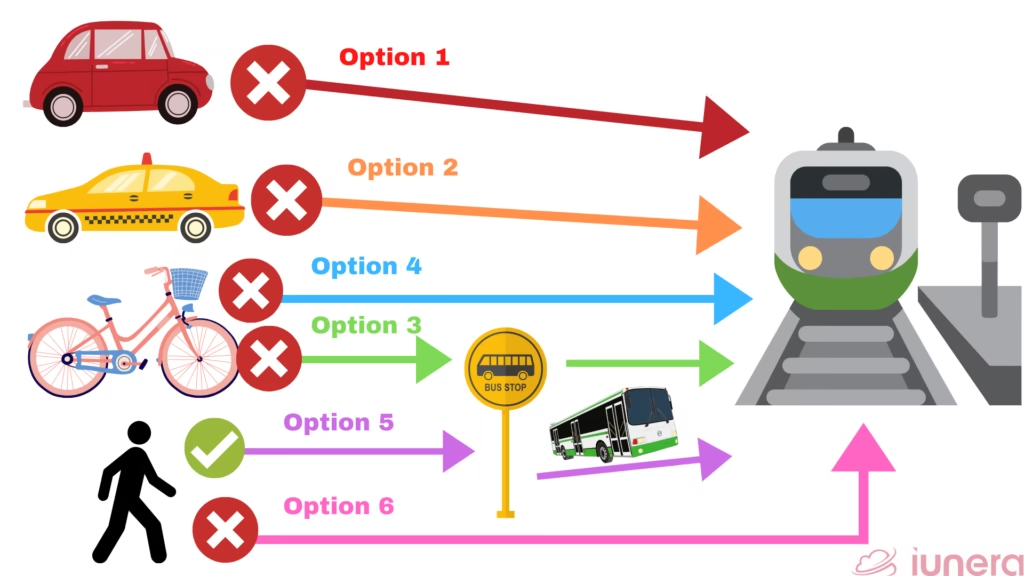
Because of its remote location, Hawaii is accessible mainly by air and sea. Most travelers arrive by plane, with several international airports across the islands, the busiest being Daniel K. Inouye International Airport in Honolulu. Flights operate daily from major U.S. cities. Cruises are another, slower option that typically depart from the West Coast. Within the islands, interisland travel is facilitated by domestic flights, as there are no bridges or tunnels connecting the islands. Ferries operate in limited areas, such as between Maui and Lanai.
Impact on Tourism and Economy
Hawaii’s distance from the mainland significantly affects its tourism and economy. Because it requires more time and expense to reach, Hawaii tends to attract travelers planning longer stays or special vacations. This isolation also means that many consumer goods must be imported, raising costs for residents. However, tourism remains Hawaii’s largest economic driver, with millions of visitors arriving annually. The scenic beauty, unique culture, and remote appeal make Hawaii a dream destination despite the logistical challenges posed by its location.
Military and Strategic Importance
Despite its distance from the U.S. mainland, Hawaii plays a vital role in America’s military strategy. Its central location in the Pacific makes it a key outpost for defense and logistics. Pearl Harbor, located on the island of Oahu, is home to one of the largest U.S. naval bases and holds great historical significance. Hawaii also hosts several Air Force and Army installations. Its strategic position allows rapid deployment across the Pacific region, making it essential for national security and international operations.
Cultural Differences and Unique Identity

Hawaii’s physical separation from the mainland has helped preserve its unique cultural heritage. The islands are home to a rich blend of Native Hawaiian traditions, Polynesian influences, and Asian and Western cultures. Language, food, music, and customs often differ significantly from those found on the mainland. The concept of “Aloha” reflects not only a greeting but a deeper cultural philosophy of respect, community, and love. Hawaii’s distinct identity is a direct result of its geography, history, and diverse population.
Conclusion
Hawaii’s considerable distance from the U.S. mainland—both geographically and culturally—makes it one of the most unique states in the nation. While this distance presents challenges in travel, communication, and cost of living, it also contributes to the islands’ special appeal. From its strategic military value to its rich cultural heritage and economic reliance on tourism, Hawaii’s position in the Pacific is far more than just a number of miles. It’s a reminder of how diverse and expansive the United States truly is.
You Can Also Read: USA to India Flight Distance Time
FAQS
How long does it take to fly from the US to Hawaii?
Generally speaking, it’s at least about 5 or 6 hours to fly to Hawaii from the west coast of the USA; 8 to 10 hours from the midwest and approximately 11 to 12 hours from the east coast.
How far is Hawaii from Mainland, US?
about 2,000 miles
Hawaii (/həˈwaɪ.i/ hə-WY-ee; Hawaiian: Hawaiʻi [həˈvɐjʔi, həˈwɐjʔi]) is an island state of the United States, in the Pacific Ocean about 2,000 miles (3,200 km) southwest of the U.S. mainland.
Which US city is close to Hawaii?
The closest mainland state to Hawaii is California. Measuring the distance to the centers of places in California, I find that Honomu is 2287 miles from the small city of Point Arena in Mendocino County, and 2318 miles from the large city of San Francisco.
What country is closest to Hawaii?
The closest country to Hawaii is the United States of America. Hawaii is a state located in the United States and is therefore not a separate country. The next closest country is Japan, located about 2,500 miles (4,000 km) to the west of Hawaii.
What is special about Hawaii?
Home to the world’s most active volcanoes, the only royal palace in the U.S. and the welcoming aloha spirit—Hawaiʻi is like no place on earth.
What language is Hawaii close to?
Linguists agree that Hawaiian is closely related to Eastern Polynesian, with a particularly strong link in the Southern Marquesas, and a secondary link in Tahiti, which may be explained by voyaging between the Hawaiian and Society Islands.
[…] the US and UK have strong education systems, but they differ in structure and focus. The UK is known for its prestigious universities, like […]
Your blog is a testament to your expertise and dedication to your craft. I’m constantly impressed by the depth of your knowledge and the clarity of your explanations. Keep up the amazing work!